My return to New York was also a return to the movies, and the city continues to be the best place for film lovers in the world. Yes, L.A., even better than you.
Roberto Rossellini's Voyage to Italy (1954) (or as it's referred to just about everywhere but the Film Forum calendar, Journey to Italy) has managed to elude much attention from scholars and film fans over the decades since its release, despite (or perhaps because of) the fact that it paired the director with his controversial real-life amour Ingrid Bergman. Andrew Sarris and Francois Truffaut, the original auteurist scholars, were admirers of the film, but it has largely been forgotten in favor of focusing on Rossellini's pre-Bergman work. It's interesting to consider that even as his marital indiscretions with his Swedish muse and wife have been forgiven over time, his films with her still tend to be dismissed. One has to wonder why this particular film has been chosen for a re-evaluation over their other collaborations; Stromboli (1950) is particularly interesting, and has much in common with his neo-realist origins, and Fear (1954) is a fine psychological thriller. Both are better than Voyage to Italy. Beautifully restored by the consistently great Cineteca di Bologna, the re-release of Voyage to Italy is not a complete waste of time, but is also not a revival to get overly excited about.
Bergman and George Sanders play Catherine and Alex, a British couple on their first vacation together alone, driving through Italy to reach Naples, where Alex hopes to place his late uncle's villa on the market. As the two begin to notice that not only are they happier when they are without the other, but they are developing overwhelming romantic desires for others, the journey becomes more uncomfortable and reaches a boiling point with an explosive argument over a borrowed car that leads to words they both wish were never spoken.
We are really given very little information about who Catherine and Alex are, making their eventual discovery that they don't really know each other very well slightly more effective. We don't know either. Sanders, who always tended to be smug and condescending in everything he did, provides vivid contrast to the emotional highs often found in Bergman's performances. If they seem mismatched, all the better. This is a couple that has very little in common, except perhaps the fact that they don't love one another. Based on a novel by Colette, the woman we can also blame for Gigi (1958), the slight narrative of the film is enlivened by striking black and white cinematography by Enzo Serafin. The camera prowls the museums, ruins, and streets of Naples and Pompeii, serving as a fine travelogue of 1950s Italy while also providing comparisons between the doomed couple and the stone works of art. There are also interesting casting choices that outsider film fans will admire. Paul Muller, later to become a member of Jess Franco's regular troupe of thespians, plays a beatnik-type tagging along with a trio of free-wheeling lady tourists, and Leslie Daniels, appearing here as the caretaker of Alex's uncle's villa, somehow followed up his esteemed work in European arthouse films with a memorable co-starring role as the doctor's assistant whose arm is gorily torn off in The Brain That Wouldn't Die (1959/62). From Rossellini to Jan in the Pan...that's quite an actor's journey.
A disastrous ending can completely undo a film, no matter what good came before it. In the case of Voyage to Italy, the final scene seems to contradict everything Rossellini was trying to accomplish in his exploration of a marriage disintegrating. If this was the ending of the novel, it's a wonder that the director even bothered adapting it in the first place. For the master of Italian neorealism to conclude his story with a wildly unrealistic and stylized Hollywood ending voids much of the film's effectiveness. It destroys what could have been a minor, but noteworthy entry in his oeuvre.
You probably know of The Source Family (2012) even if you think you don't. If you've seen Annie Hall (1977), Just the Two of Us (1970), Alex in Wonderland (1970), or Cisco Pike (1972), the Source restaurant, a mainstay of the Sunset Strip in 1970s Los Angeles and home to the Family, is featured prominently in key sequences in those films. As featured in this documentary, the Family even inspired a skit on "Saturday Night Live". Where the Manson Family and Jim Jones' Peoples' Temple have shifted public awareness of cult mentality into negative images of mass murder, mindless followers, and megalomaniacal leaders, Jim Baker's Source Family was quite a different animal. This group began with a health food store and blossomed into a 140-person commune of men, women, and children following a self-written philosophy combining the best elements of major world religions. Of course, all good things must come to an end, and the Family's existence lasted a mere five years before Baker's unusual behavior (including adopting 13 wives and moving the family headquarters to Hawaii) led to family members heading for the hills and eventual group disintegration following their leader's death. Baker, known first as Father Yod and then as YaHoWha within the Family, had a fascinating life story even before he, but to reveal more of this unusual story would rob you of the wonderful surprises in store for the adventurous spectator.
The most incredible aspect of the documentary is the sheer volume of archival material used. Assigned by Baker with the task of documenting the Family and its history, Isis Aquarian (the film's associate producer, and ex-girlfriend of famed photographer Ron Raffaelli, also interviewed here) captured daily life, meditations, and key events of the Family's existence in photographs, audio recordings, and home movie footage. Maybe the best material is to be found in the film's soundtrack, made up entirely of original recordings by the Family's rock band, the YaHoWha 13, which released a staggering nine albums in a very short period of time. Original copies of the LP's sell for top dollar among collectors today, but the curious can check out the few CD releases available. Most are available on iTunes listed either under Father Yod and the Source Family or the Yahowha 13. There is even a mammoth 13-CD boxed set, now out of print, that looks to be the final word on the musical world of the Source Family.
5. Heroes for Sale w/ Wild Boys of the Road (Film Forum)
4. What Have You Done to Solange? (Anthology Film Archives)
3. Dial M for Murder in 3-D (Film Forum)
2. Bonjour Tristesse (Film Forum)
1. Don't Torture a Duckling (Anthology Film Archives)
Based on my top 10 favorite experiences seeing classic/vintage movies in a theater, Film Forumand Anthology Film Archivestie as the best repertory theaters in the city for me.
Movies by Theater:
Those marked in red were bad experiences due to patrons, print issues, or the movie itself.
Those marked in gold were the best/most memorable experiences I had in 2012.
Angelika Film Center (4) Jan. 26 - We Need to Talk About Kevin (2012)
Sep. 9 - Hello I Must Be Going (2012)
Dec. 14 - Silver Linings Playbook (2012) Dec. 17 - The Sessions (2012)
Anthology Film Archives (18) Mar. 1 - From the Pen of...: Smile (1975)
April 7 - Spanish Cinema of the Early Post-Franco Era: The Disenchantment (1976)
April 8 - Spanish Cinema of the Early Post-Franco Era: Ocana: An Intermittent Portrait (1978) Sep. 8 - From the Pen of...: Payday (1973) Sep. 8 - From the Pen of...: The Innocents (1961)
Sep. 14 - From the Pen of...: The Stepfather (1987) Sep. 14 - From the Pen of...: Cops and Robbers (1973) Sep. 16 - From the Pen of...: Walk on the Wild Side (1962)
Sep. 16 - From the Pen of...: The Loved One (1965) Sep. 17 - From the Pen of...: The Panic in Needle Park (1971) Sep. 17- From the Pen of...: Play It as It Lays (1972)
Sep. 21 - Giallo Fever: House with Laughing Windows (1976) Sep. 21 - Giallo Fever: Don't Torture a Duckling (1972)
Sep. 22 - Giallo Fever: The Strange Vice of Mrs. Wardh (1971) Sep. 22 - Giallo Fever: Deep Red (1975) Sep. 22 - Giallo Fever: What Have You Done to Solange? (1972)
Sep. 23 - Giallo Fever: The Girl who Knew Too Much (1963) Sep. 23 - Giallo Fever: One on Top of the Other (Perversion Story) (1969)
Cinema Village 7 April 27 - Tribeca Film Festival: Side by Side(2012) City Cinemas East Village
Sep. 22 - The Master in 70mm (2012)
Film Forum (34) Feb. 9 - Pretty Poison (1968) Feb. 13 - Wellman: Chinatown Nights (1929) & Woman Trap (non-Wellman, 1936) (2) Feb. 14 - Wellman: Nothing Sacred (1937) & A Star is Born (1937) (2)
Feb. 16 - Wellman: Night Nurse (1931), The Purchase Price (1932) & The Man I Love (1929) (3) Feb. 17 - Wellman: Heroes for Sale (1933) & Wild Boys of the Road (1933) (2)
Feb. 21 - Wellman: Stingaree (1934), Central Airport (1933), & Safe in Hell (1931) (3) Feb. 24 - Wellman: Track of the Cat (1954) & Westward the Women (1951) (2)
Feb. 27 - Wellman: The Young Eagles (1930), The Conquerors (1932) & Frisco Jenny (1932) (3) April 2 - The Long Day Closes (1992)
April 9 - Ruggles of Red Gap (1935) April 23 - The Gang's All Here (1943) April 30 - Bonjour Tristesse (1958) May 10 - Celine and Julie Go Boating (1974)
May 11 - Grand Illusion (1937) Celebrity sighting: Peggy Steffans Sarno
Sep. 3 - French Old Wave:The Earrings of Madame de... (1953)
Sep. 3 - The Good, the Bad and the Ugly (1966)
Sep. 5 - French Old Wave: Le Million (1931) & A Nous la Liberte (1931)
Sep. 9 - French Old Wave: Orphee (1950) & Beauty and the Beast (1946)
Sep. 16 - Port of Shadows (1938) Sep. 29 - Dial M for Murder in 3-D (1954)
Oct. 16 - Creature from the Black Lagoon in 3-D (1953)
Dec. 17 - Consuming Spirits (2012)
IFC Center (7)
Feb. 4 - Kill List (2011)
Feb. 26 - Oscar-Nominated Live Action Shorts (2011)
Feb. 26 - Oscar-Nominated Animated Shorts (2011) Sep. 8 - Detropia (2012)
Sep. 8 - Girl Model (2011) Oct. 7 - The Man who Knew Too Much (1934)
Dec. 17 - It's a Wonderful Life (1946)
Lincoln Center - Francesca Beale Theater Sep. 9 - Keep the Lights On (2012)
Lincoln Center - Howard Gilman Theater
Oct. 1 - 50th New York Film Festival: Pursued (1947)
Lincoln Center - Walter Reade Theater (15) Feb. 10 - Cinematic Goddess, American Sex Symbol: Myra Breckinridge (1970) Feb. 12 - Cinematic Goddess, American Sex Symbol: Kansas City Bomber (1972)
Feb. 12 - Cinematic Goddess, American Sex Symbol: Hannie Caulder (1971)
Feb. 12 - Cinematic Goddess, American Sex Symbol: The Last of Sheila (1973) Feb. 23 - Film Comment Selects: Silent House (2011) Feb. 23 - Film Comment Selects: Headhunters (2011)
Mar. 10 - Rendez-Vous with French Cinema: Last Screening (2011)
Mar. 10 - Rendez-Vous with French Cinema: 38 Witnesses (2012)
Mar. 22 - New Directors/New Films: Las Acacias (2011) Mar. 24 - New Directors/New Films: Goodbye (2011) Mar. 24 - New Directors/New Films: The Raid: Redemption (2011) Mar. 24 - New Directors/New Films: How to Survive a Plague (2012) Mar. 29 - New Directors/New Films: Oslo, August 31 (2011)
April 1 - New Directors/New Films: Porfirio (2011)
Oct. 1 - 50th New York Film Festival: Liv and Ingmar (2012) Celebrity sighting - Ricky Jay
Museum of Arts and Design April 19 - Argento: Il Cinema nel Sangue: Suspiria (1977)
Museum of Modern Art (MoMA) (17) Mar. 14 - Canadian Front 2012: Sunflower Hour (2011) Mar. 14 - Canadian Front 2012: Monsieur Lazhar (2011)
Mar. 15 - Canadian Front 2012: Mesnak (2011)
Mar. 16 - Canadian Front 2012: Romeo Eleven (2011) Mar. 16 - Canadian Front 2012: Starbuck (2011) Mar. 18 - Canadian Front 2012: Cafe de Flore (2011) Mar. 18 - Canadian Front 2012: Roller Town (2012) April 3 - Carte Blanche: Cindy Sherman: Fuego (1969)
Oct. 11 - To Save and Project 10: Call Her Savage (1932) Oct. 11 - To Save and Project 10: Wild Girl (1932) Oct. 14 - To Save and Project 10: Anarchist Movies of the Spanish Civil War - Report on the Revolutionary Movement (1936) & Carne de Fieras (Flesh of Beasts) (1936) Oct. 14 - To Save and Project 10: Barrios Bajos (Slums) (1937) Oct. 14 - To Save and Project 10: Tell Me Lies (A Film About London) (1968) Oct. 16 - To Save and Project 10: San Diego Surf (1968) Oct. 17 - To Save and Project 10: Sparrers Can't Sing (1963) Oct. 17 - To Save and Project 10: Genghis Khan (1950)
Museum of the Moving Image (MoMI) (3)
Jan. 28 - David Cronenberg: They Came from Within (1975)
Jan. 28 - David Cronenberg: Rabid (1977) May 11 - Fashion in Film: If Looks Could Kill: Ms. 45 (1981)
Regal Union Square
Nov. 12 - Skyfall (2012)
Tisch - Cinema Studies Cinematheque
Dec. 7 - You and Me (1938) &Remember the Night (1940)
Report on the Revolutionary Moment (1936) & Carne de fieras (Flesh of Beasts) (1936)
Introduced by Spanish anarchist film historian Edouard Waintrop, these films unfortunately didn't feature enough historical context in their prefaces to enforce their historical importance. The first film, a 22-minute newsreel (with photography and production credits to Fox Movietone), captures rebel forces against Franco as they prepare to do battle with fascist forces nation-wide. Where the newsreel wears its anarchist leanings proudly, Carne de fieras is a very different animal. Hiding beneath the veneer of a standard romantic comedy beats the heart of anarchism, not just behind the camera, but in front of it. Successful boxer Pablo, married to a philandering wife, adopts young street urchin Ten Cents after saving the boy's life from drowning. The young comic pipsqueak and Pablo's trainer, Picatoste, become his only confidants when the athlete discovers his wife in her singer lover's embrace. Hoping to distract him from the cuckolding and a recent loss in the ring, Picatoste averts his gaze to Marlene, a beautiful French woman who dances topless in a cage while her co-star, General Marck, keeps the lions and tigers surrounding her at bay. But the lovely vision is pursued by her creepy, possessive servant, Lucas, who threatens to kill anyone who tries to take her away from him.
The cast and crew of Carne de Fieras, captured as ghosts in this photograph
The history behind the film is more intriguing than what appears on the screen. First of all, the feature was never completed. The Spanish civil war halted production and it was never resumed, as director Armand Guerra took his cameras to the battlefields of the war. He and his family fled the country soon after the filmmaker was labeled a propagandist for the rebel cause, and he died of an aneurysm in Paris in 1939. Neither female lead survived the 1930s. Blonde bombshell Marlene Grey, a true-life performer with wild cats, was mauled to death by a tiger during a performance in Marseilles in 1939. Brunette femme fatale Tina de Jarque worked with the rebels as a spy, performing at Republican events and gathering information to relay back to rebel forces, and was captured and executed in 1937 as she attempted to escape with her lover and thousands of dollars in jewels over the Spanish border to safety in France.Despite the film's producers surviving the civil war, they could never hope to make money off completing, editing, and releasing the film: its surprising nudity (Marlene Grey's topless performances are seen twice) and themes of adultery and divorce would have run afoul of the Spanish Republican censors.The footage remained buried in a closet for decades. Sadly, no one remembers the name of the charming young child actor who plays Ten Cents. The film has become a ghost of its former self, capturing a pre-Franco moment in time and the last time many of the film's cast and crew would ever be seenor heard of alive again. The flow of the narrative is understandably fractured, as several key scenes were never shot before bombs started falling around Madrid, but what remains, edited together and restored in 1992 by the Cinematheque de Zaragoza, is a whimsical folly whose charms gleefully overshadow the darkness surrounding its production history.
The doomed Marlene Grey doing her wild cat cage dance
CARNE DE FIERAS in its entirety, in Spanish language only.
Barrios Bajos (1937)
Recalling the best of America's pre-Code shockers, Barrios Bajosis a mix of proto-noir imagery and angst-ridden melodrama, not completely satisfying but an intriguing curio none-the-less. Translated as Slums, the sordid back alley narrative begins with a woman's scream and a man scurrying from his upper-class apartment building, finding solace in a dingy bar where a woman croons the title song for an appreciate audience of winos and whores. Ricardo has killed his wife's lover, and the police are on the hunt. The newspaper boys scream "Crime of passion!", leading him to seek shelter in the home of his old friend Valencia, an ex-con now working at the docks for meager wages. Meanwhile, deceptively friendly Rita encourages a drunkard to return home to his wife, Rosa, who leaves in a rage right into the arms of the elderly woman, eager to bring the young woman into her house of ill repute, overseen by slimy pimp Floreal. However, the two sex traders don't count on Valencia taking a shine to Rosa, who resembles his late wife, and protecting her from a life of prostitution by securing her a job as a barmaid in the bar below his apartment. Floreal sends his bleached blonde mistress Mae to discover the identity of Valencia's mysterious roommate Ricardo, believing the truth will enable him to blackmail Rosa into joining his stable.
Of course all of this sounds like good, scummy fun in the vein of Warner Brothers' memorably provocative social dramas of the 1930s. There is an extended sequence of Rita's prostitutes arriving to the town port in cars at 3am to service a ship full of sailors, as well as shocking moments of Rita letting a man visibly sniff cocaine off her finger to ease his wallowing pain and Mae having her head smashed through a glass window! Where the Hays Code stopped this kind of material from being shown, or even hinted at, in the United States by 1934, General Franco would ensure that Spanish cinema would not encourage this kind of behavior up until his death in 1975, by which time American cinema had embraced all manner of previously censored material, including hardcore pornography. This is what makes Barrios Bajos such a special film. Despite problematic pacing and a few performances that miss the mark, director Pedro Puche features so many jarring moments in his rather predictable crime story-turned-love triangle that it oddly succeeds at winning over the audience.As Valencia, the film belongs completely to Jose Telmo, in a performance that recalls, again, the working-class heroes of Warner Brothers. Pilar Torres' Mae is a cheap, sleazy delight, stealing scenes whenever she swaggers on-camera.
If you speak Spanish, you can watch the whole film above. No Spanish needed to enjoy Pilar Torres.
Tell Me Lies (A Film About London) (1968)
Perhaps best known for directing Lord of the Flies (1963), Peter Brook made his biggest mark in the world of English theater,working as official director of the Royal Shakespeare Company for two decades.His cinematic adaptation of Marat/Sade (1967) raised eyebrows, and he utilized most of the same cast (from his theatrical company) for the rarely-seen docudrama Tell Me Lies, one of the most provocative and unique films about the Vietnam War I have ever seen. There is nothing quite like it.
Actors Mark Jones and Robert Lloyd (as well as Mark's live-in girlfriend, Pauline Munro) are moved by a magazine pictorial on civilian injuries in Vietnam to do their own documenting and research into the anti-war movement taking place in London. Scenes of actors playing MP's wildly dancing at a party to a pro-Vietnam rock song mix with real veterans and protesters sharing their thoughts on the conflict. The famous, and still horrifying, footage of the self-immolation of a Buddhist monk appears, as well as newsreel footage of Viet Cong street executions and American soldiers feeding young Vietnamese children, now homeless after napalm wiped out their villages. Notorious black civil rights figure Stokely Carmichael talks about freedom and peace with lovely, soft-spoken French-Vietnamese Jacqueline Porcher, the cast breaks into catchy musical numbers, Glenda Jackson (pre-Oscar and pre-dental work) plays a protester who reveals by film's end that she prefers being isolated from the conflict so she can maintain distance from it, Jones dreams about blowing up the American Embassy and imagines himself a US soldier drawn into a Saigon gay bar to connect with other men, Lloyd re-enacts the self-immolation of Quaker Morrison, an unnamed American comedy troupe (including Bill Macy before "Maude") perform "101 Things to Say to Get Out of the Draft", and many other whacky, controversial sequences weave in and out of the unusually structured narrative. Brook admitted during his post-screening Q&A that the film did not begin with a defined shape, a process which took place in the editing phase. One gets the feeling that he and his cast came up with ideas on the fly and whichever ones worked the best made it into the finished film. It gives most of the film a kind of improvised, free-flowing spirit that frequently works in its favor.
A soundtrack album was actually released! I want it!
Restored from a recently discovered internegative at the BFI, Tell Me Lies mixes bold color with stark black-and-white for an interesting palette, though the film never defines the reasoning behind the coloring of each individual sequence. At 118 minutes, the film threatens to wear out its welcome in several instances, but the clock stops during riveting moments like a lengthy, heated debate at a dinner party between Jones, Munro, and several stuffy members of Parliament, the aforementioned Carmichael-Porcher conversation, and Jackson's final act confession. With BFI's track record of sterling DVD/Blu-Ray releases, here's hoping Tell Me Lies hits the format very soon so it can be rediscovered by a generation of viewers who could benefit from its radical, angry vision.
The re-release trailer for TELL ME LIES, including the catchy title theme song
MoMA's To Save and Project Festival, dedicated to screening recently restored and preserved films from archives and studios around the world, opened its 10th annual event with a brand-new restored print of Clara Bow's 1932 comeback vehicle, Call Her Savage. A little back story is necessary to put the importance of this film into context. In the second half of the 1920s, Clara Bow was the most famous movie star in the world. She was the top box office star for Paramount Studios, and also regularly beat better-regarded stars at more prestigious studios in ticket sales. Star, studio, and public were exceedingly happy with the "It Girl" persona and its lucrative rewards until the business transitioned into sound, causing Brooklyn-born Bow panic attacks about her voice, fearing a childhood stutter would re-emerge. The mix of Bow's personal problems with the new technology and dwindling box office returns when Paramount continued to stick her in formula "It Girl" films led to her early retirement in 1931. A year later, Fox offered her a two-picture deal to return to the screen, and the results were Call Her Savage (1932) and Hoop-la (1933).
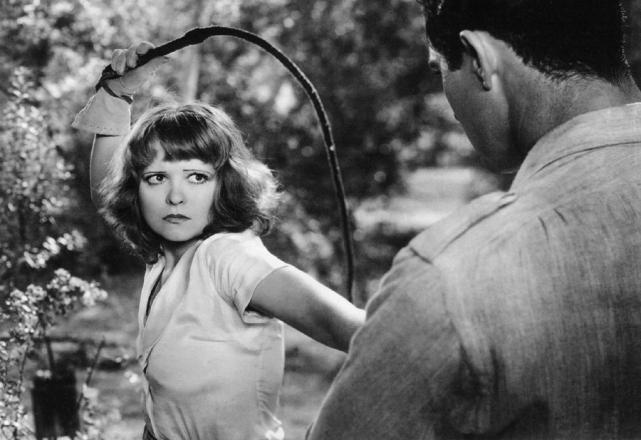
Clara brandishing her bullwhip
In Savage, Bow plays Nasa Singer, a wild hellion introduced riding her horse while screaming "Yippee!" before being thrown yards away from a rattlesnake, which she proceeds to bullwhip back into the brush, and turning the whip on her family servant, Moonglow, when she hears him laughing at her fall. Nasa's temper will continue to haunt her as she marries a sleazeball gigolo to spite her stuffy father, gets into a catfight with a woman who taunts her nickname "Dynamite", and sinks her engagement to a millionaire's son by destroying the dinner table during another fight at a dinner party. The ultimate journey of the film is to discover the root of her anger, but there is no suspense in the search for truth because the audience has been privy to Nasa's mother's affair with an Indian brave in the first act of the film.
Pre-code Clara
In all of its pre-Code glory, Savage has some decidedly provocative moments. Bow's erect nipples are seen through a shirt and a nightgown in separate scenes; Bow's slimy husband is introduced coyly discussing his and his girlfriend's hotel affairs; gambling and drinking rums rampant in the high society life; a major character develops mental illness from a bad case of venereal disease; Bow prostitutes herself to pay for medical prescriptions; a child dies in a fleapit hotel fire; and characters slum in a Greenwich Village gay bar, where queer waiters perform a song in maid drag (an unbilled Mischa Auer appears in this scene). And most miraculously, Bow's character goes unpunished for any of her wrongdoing. In fact, the abrupt ending is just one of the myriad of issues plaguing the film. It is the capper to a script with no clear sense of what kind of film it wants to be. The film can be split into chapters, which might be sensible considering it's based on a novel, except none of them really gel together. Gilbert Roland, one of Bow's long-time paramours, plays Moonglow, a character hinted at as the right man for our heroine, but that proposed scenario never materializes. Thelma Todd and Monroe Owsley steal more scenes than they should as Bow's chief nemeses.
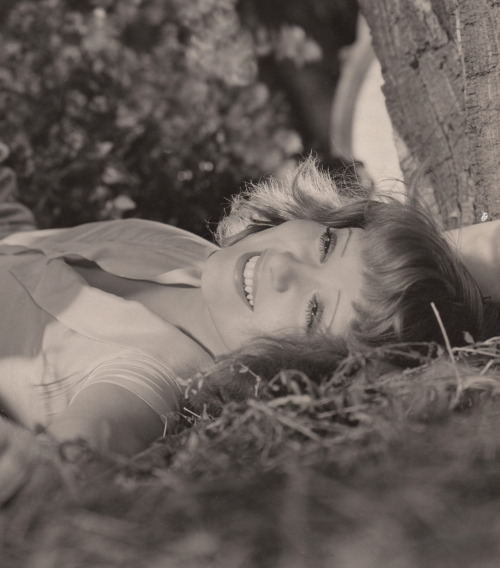
Clara's winning smile
Of all the problems with Savage, Clara Bow is not one of them. Her character is poorly drawn, but her performance is funny, bold, and touching at all the appropriate times. Despite the concerns of the studio and Bow herself regarding her voice, there is not one thing wrong with it, nor her dialogue delivery. But where her performance sings, and where it always did, especially in the silent days, are in wordless moments. Bow was a seventh-grade dropout, never took an acting class in her life, who became a star because of her natural ability to inhabit a character so fully that the audience is completely on her side, man and woman, falling in love with her. When her face lights up with mischief and joy, the audience smiles and laughs, hearts singing. When her breezy sexuality is at its most enticing, men want her completely and women want her "It" for themselves. When her eyes well with tears (and Bow remains one of the few brilliant screen criers), the audience cries with and for her. You don't need words for these emotions, and that is where even in her sound films, Bow is a resounding success. She overcomes the considerable production issues of her films simply by being Clara Bow. There are few like her, then and now. If you aren't familiar with her work, discover what you are missing. If you don't like her, we have nothing more to say to each other.
It's interesting to note that Bow considered this one of her favorite films, though I personally think the better film, also containing the better performance, is her very last feature, Hoop-la, screened at last year's To Save and Project. The notoriety surrounding Savage, as well as its slightly more accessible availability,has earned it more acclaim, while Hoop-la receives little to no attention today. This is a shame. It deserves the accolades Savage has received over the years. But both stand as testament that Bow could have had a successful talkie career, with a better studio behind her and if she had actually wanted to continue. She left Hollywood of her own choice, before the cruel business had the chance to toss her out when it was done exploiting her.
The first four minutes of Clara Bow on-screen in CALL HER SAVAGE.
Wild Girl(1932)
Joan Bennett as "wild girl" Salomey
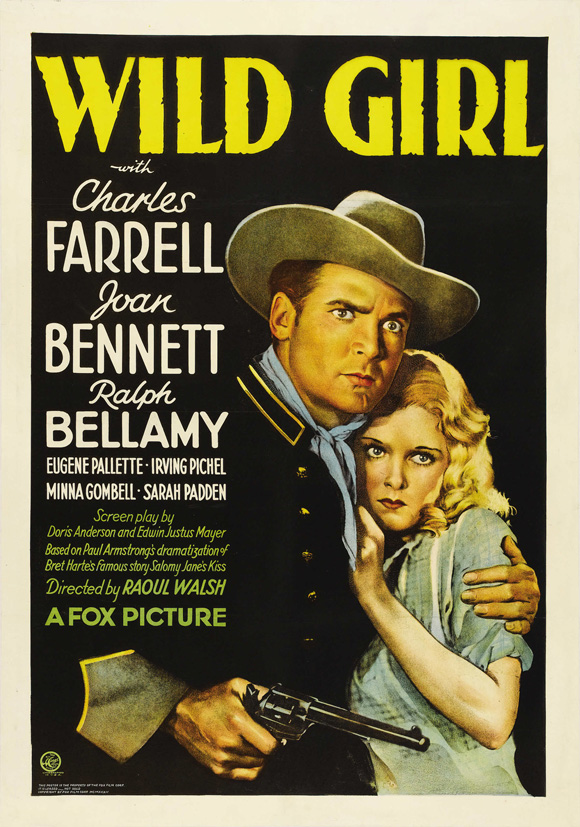
The same year as Call Her Savage was attempting to revitalize Bow's career, Raoul Walsh was shooting a much more satisfying pre-Code melodrama for Fox. Shot entirely on location in Sequoia National Park, Wild Girl is a beautifully stylish backwoods tale with an unusual love quadrangle and some disturbing and provocative imagery. Based on a play, which was itself inspired by a short story, "Salomey Jane's Kiss", Walsh's pulpy tale follows Salomey, a tomboyish country girl living on a woodland property close to Redwood, CA. She is pursued by handsome poker player maverick Jack Marbury and weaselly bloodhound owner Rufe Waters, as well as lecherous mayoral candidate Phineas Baldwin, but her heart is won by a mysterious stranger who wanders into town and shoots Baldwin for wronging his sister back in Virginia. Several other sordid crime subplots interweave with the love story of Salomey and the stranger, but in a satisfying and ultimately rewarding way.
Salomey and the "wild children" of the woods
I will admit, Raoul Walsh has completely flown under my radar over the years. While Andrew Sarris and other critics and academics have sung his praises in the re-appreciation of lesser-known Hollywood auteurs, Walsh has primarily avoided my interest because of his frequent work in the western and action-adventure/war genres, never my favorites. Now that I've seen two of his films in the space of two weeks, it's safe to say that I need to see more of them. He has an interesting visual eye, made all the more intriguing because he wore an eye patch. The photography in the film is breathtaking, capturing the light shining through the huge trees splendidly, and the location work is even more stunning considering this is still early on in the sound era. In delightful pre-Code moments, a skinny-dipping Salomey meets the stranger for the first time as he wanders into the lake to quench his horse's thirst (the four backwoods children she swims with are also seen nude from behind in rather startling footage); the shooting of Baldwin is surprisingly graphic; the myriad of prostitutes and saloon girls, including wise-cracking Millie (the marvelous Minna Gombell), who cackles as the supposedly moral Baldwin lays dying at her feet, are portrayed frankly; and the Sheriff and his men lynching a stagecoach robber in the woods is a haunting sequence. The events in the film are connected by a unique framing device: the entire film is realized as a visual book, with the opening credits featuring the actors in character introducing themselves, and the standard transitional wipes are transformed into turning pages. It adds an otherworldly literary feel to the film, more successfully than the novel-like Savage, and accents Walsh's frequent and picturesque fairy tale images (including an introductory sequence of Salomey and her Mammy rushing down a mountain overrun by baby bears that scurry into the trees and bushes as the humans approach). This is a real jewel of a movie, not as well-aged and fascinating as other films of the same era from Warner Brothers and RKO, but just as deserving of a contemporary audience. Let's hope that this restored version, as well as Bow's two beautifully preserved Fox films, will see home video release soon.
Ralph Bellamy and Eugene Pallette play cards behind the scenes
Before she became a brunette femme fatale in the 1940s, Joan Bennett was modeled as an almost identical blonde surrogate to her older sister, Constance, also a successful ingenue type during this period. While Constance would be used to greatest effect in comedies like Merrily We Live (1938), Topper (1937), and Our Betters (1933), Joan excelled in melodramatic parts like Salomey Jane in Wild Girl. She's quite superb and surprisingly natural here, without the haughty tones she would adopt later in her career. Male lead Charles Farrell was most popular in the silent years, perhaps most memorably as Janet Gaynor's love interest in Borzage's Seventh Heaven (1927). While John Gilbert was drummed out of Hollywood when the microphone revealed his high-pitched voice did not match his swarthy ladies' man image, Farrell somehow survived into the 1930s despite a similar handicap. He's handsome enough, but some viewers may be left wondering why in the Hell Salomey doesn't go for Ralph Bellamy, perhaps never more charming and handsome as gambler Jack Marbury. Always-welcome character actor Eugene Pallette, with his bullfrog voice and bug-eyed reaction shots, reliably steals scenes left and right (remember My Man Godfrey?). Unbilled as Salomey's Mammy is Louise Beavers, making the most of a thankless and stereotypical role, a few years from her ultimate performance in Imitation of Life (1934). Beavers was more talented than many white actresses of the period, but of course the color line in Hollywood kept her from getting many real chances to demonstrate her gifts.
Alas no video clips from Wild Girl. It's that rare! It is screening again at MoMA on Thursday October 18 at 4:30PM. Follow this link for more information on the screening. Obviously I highly recommend you add it to your calendar! It's one of those once-in-a-lifetime movie experiences that makes rep theater in New York City such an embarrassment of riches for film lovers.
This is not an attempt at a comprehensive William Wellman career retrospective. The man directed 76 films, not including uncredited work; the Film Forum retrospective in February 2012 only selected 42 of those (not to mention that two of the scheduled films, Woman Trap (1929) and Magic Town (1947), ended up not being screened due to print issues), of which I only saw 16. One thing I took away from the series is that Wellman is not an auteur of any kind, nor did he aspire to be. He personally wished to make films of all kinds, in every genre, and he succeeded, as will be seen below.
Early Sound:
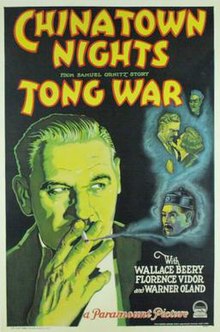
After directing one of the two first Best Picture Academy Award winners Wings (1927) (the other being Murnau's Sunrise), William Wellman established himself as one of the most promising filmmakers in Hollywood. Many of his silent features are lost, but his remaining works post-Wings demonstrate a director developing an ease with actors and a derring-do in capturing thrilling action sequences. One of the most curious films from this early period of Wellman's career is Chinatown Nights (1929), an unusual Frankenstein monster hybrid of silent and sound that is, unfortunately, difficult to see today. The film was partially completed as a silent film, but in an interesting development akin to the fate that befell the Amero Brothers' Bacchanale (1970) during the bridge between softcore and hardcore in the exploitation film market, silent films became box office poison practically overnight. The film resumed photography as a sound feature, some scenes re-shot with live sound. Full sound scenes brush shoulders with scenes clearly shot silent but poorly overdubbed in post-production. It's unlike anything I've ever seen, but frankly it works in an unusual way.
Wallace Beery, surprisingly slender compared to his later years, stars as Chuck Riley, the white leader of a Chinese Tong mob intent on starting a turf war with big boss Boston Charley (Swedish Warner Oland before his Asian drag kicked into high gear with the Charlie Chan films). Ignore the fact that both characters, in fact, have the same name (d'oh!). Chuck meets his match in a spoiled rich girl who he rescues from the dangerous streets one night, but keeps coming back for more Chuck lovin'. Of course she attempts to reform him, but it takes two tragedies, one involving a hero-worshiping street urchin played with gusto by underrated child actor Jack McHugh, for Chuck to finally see the error of his ways.
Troublesome racial politics aside (how did this white guy finagle his way into taking charge of a Chinese gang?), this is a fine, pulpy crime drama whose bizarre production history only adds to a unique viewing experience. The opening scenes, of a Chinatown tour taking high society thrill-seekers into the dangerous neighborhood to see how the "othered Orientals" live, are exciting and quite funny, especially when it is revealed that Chinese store owners indulge in perceived stereotypes for the benefit of the audience and a cut of the tour earnings. The hammy theatrical performance of Florence Vidor, as the romantic interest, has aged badly. Not surprisingly her career did not survive the transition from silent to sound. In fact, she didn't even stick around for the change herself. Her dubbed dialogue was looped by actress Nella Walker instead. The ex-wife of legendary director King Vidor never performed again. Jack Oakie as a stuttering reporter is thankfully underused.
Wellman's first full-sound feature, The Man I Love (1929), is an unfortunate disaster. He reunites with Wings star Richard Arlen for a firmly predictable tale of boxer Dum-Dum Brooks who marries a prim and proper sheet music salesgirl/pianist and is tempted by New York socialite Olga Baclanova (several years before her legendary role as the deceitful trapeze artist in 1932's Freaks). Considering Wellman's pedigree in directing action, the boxing scenes are tepid and the melodrama turgid and dull. There is virtually nothing to recommend about the film save Baclanova's sultry performance, best seen as a precursor to her definitive performance in Browning's film.
Young Eagles (1930) is another poor quality early Wellman sound feature with little of interest to distinguish itself from other films of the era. It reunites Wellman with his other male Wings star, Buddy Rogers, as one of the titular "Young Eagles" involved in an uneventful plot surrounding German air pilot Von Baden (Paul Lukas) and his capture by Rogers. There are ridiculous twists in the story that defy logic, surprising considering Wellman based this film, as well as his other WWI features, on his experiences as a fighter pilot in the first Great War. In an interesting throwback to the silent movie days (and the days of Wings), Wellman superimposes descriptive title cards over the flying sequences, several of which are merely recycled from his 1927 Best Picture winner. In addition to Rogers and Lukas, the cast includes Jean Arthur as Rogers' romantic interest, who is revealed to have a dubious side in an unexpected Mata Hari-esque turn of events. Sadly, Arthur is a chunk of wood here, displaying none of the charm and talent she would later demonstrate in classics like Mr. Smith Goes to Washington (1939) and The Talk of the Town (1942). And as a reminder that this was pre-Code, Rogers appears fully nude, though strategically framed, in a shower scene.
Pre-Code Classics:
For my money, Wellman's most prolific and interesting period was in the 1930's, when the director cranked out movie after movie at First National, the little studio that could, and its soon-to-be mother company, Warner Brothers. His work at both studios tends to flow together, as their production values and working-class aesthetics were similar. Before the Production Code began being firmly enforced in mid-1934, Wellman delivered some of the most daring and memorable films of this now highly-revered production period. Not all of them are bonafide winners, but each one offers at least a few striking moments of surprising violence, sexuality, or other taboo subjects soon to be rendered mum in Hollywood film production.
Safe in Hell (1931) is a sweaty, beastly animal of a movie. It ranks with Baby Face (1933), Three on a Match (1932), and Beast of the City (1932) in the upper tier of shocking pre-Code features that I would heartily recommend to anyone interested in seeing just how deliciously lurid Hollywood could be before Joseph Breen and his decades-long stranglehold on the industry. Forgotten 30s temptress Dorothy Mackaill plays a prostitute who burns down a hotel room where a particularly disagreeable client (an ex-boyfriend) was knocked out cold. Her current beau, a sailor, whisks her off to the Caribbean island of Tortuga, where society's ne'er do wells reside in a sleazy hotel run by Leonie (Nina Mae McKinney, one of the most noteworthy and talented black actresses of the 20s and 30s). The film follows her acceptance into the world of sweaty criminals, and her eventual undoing when the man she is accused of killing back in the States turns up alive, well, and running from the law himself on Tortuga. You will never see another movie like this, and that is a crying shame.
Opening credits and scene from SAFE IN HELL. I dare you to watch and not want to see the rest.
Barbara Stanwyck: Night Nurse (1931), The Purchase Price (1932)
Barbara Stanwyck, despite her far right leanings off-screen, is among my favorite actresses of the golden age of Hollywood, if not my very favorite. Versatile, beautiful, and strikingly contemporary (her performances have aged amazingly well), one of her earliest performances, in Wellman's Night Nurse, is one of her very best. She plays a young woman eager to become a nurse and help people, working in a hospital with best friend and comic relief Joan Blondell (always radiant and winning) before being assigned a plum position as the caretaker for two sick children in a wealthy home. One of the children is played by Marcia Mae Jones, soon to become one of the most talented and underrated child actresses of the 1930s; see her work in These Three (1936) and as both good and bad girls in two Shirley Temple films, Heidi (1937) and The Little Princess (1939) respectively. Her crippled girl walking scene in Heidi is a tearjerker. But I digress. Stanwyck discovers that the children are being slowly poisoned and not treated properly by the family doctor, and when her cries of malpractice are ignored by hospital personnel, the tough and dedicated woman makes it her mission to save her charges. It doesn't help that their mother is an alcoholic mess who has endless parties at her house. The surprise hero is Stanwyck's beau, a bootlegger with connections. The ending is unexpected and still packs a wallop! Much is made in contemporary reviews of the film of Clark Gable, in another early role, as the devious chauffeur anxious to get rid of the children to collect their inheritance money. He is appropriately seedy, even socking Stanwyck in the face and knocking her out cold when she threatens to call the police.
Theatrical trailer for NIGHT NURSE, which sells the film pretty well. Stanwyck is dynamite!
Where Night Nurse is practically perfect entertainment, Purchase Price is, for the most part, a dreadful disappointment. With Stanwyck in the lead, you honestly can't go that wrong. Seriously, the woman was never bad in anything. But Wellman is handed a potentially interesting premise and characters and simply doesn't know where to go with them. George Brent, early in a career of debonaire romantic leads, is the mild-mannered farmer who purchases Stanwyck as a mail order bride, as she attempts to run from her wild life in the big city. Lyle Talbot (almost forgotten today, but a reliable pre-Code regular before his Ed Wood days in the 50s) is the ex-boyfriend who tracks her down and tries to force her back to the city. Stanwyck can do no wrong, but the movie just...is missing something... The final 10-15 minutes, where the couple really bands together to make their farm a success, are the highlight of the film.
As disappointing as Purchase Price is, The Conquerors (1932) is far worse. The primary problem with the film is the combination of wooden leading man Richard Dix (more on him later) and overly theatrical leading lady Ann Harding. Neither performer makes much of an impression, and they have the film stolen out from under them by reliable character actors Edna May Oliver and Guy Kibbee. The epic story of a couple's trek out west and their family history through decades of economic and technological struggles must have been intended as a pick-me-up during the Depression, as two previous financial crises are covered (Dix's main character is a banker), but eventually one just wishes the saga would end. One memorable scene sticks in the mind: the arrival of the first train in a frontier town is the scene of a horrific car accident that takes the lives of two important characters. Wellman's talent in staging and photographing suspenseful action sequences is evident here, and the film could have used more moments like this to resuscitate the plodding narrative. Watch for little Wally Albright, better known as an "Our Gang" regular back in the early days of Spanky (he actually played Spanky's older brothers in a few shorts).
Frisco Jenny (1932) is a film with a bold female character one would expect Stanwyck to play, but instead we get Ruth Chatterton, whose reputation for a diva attitude had branded her impossible to work with by the time she wandered onto Wellman's set. Chatterton's stage-bound performances are probably the reason her star status is largely forgotten today. She was nominated for an Oscar in 1929 for her work in the original Madame X, which Jenny bears more than a passing resemblance to. Frankly, her work here is far superior to the stagey melodramatic excess of X. Wellman's eye for action makes the San Francisco earthquake sequence a hair-raising one.
Original trailer for FRISCO JENNY. Ah, Ruth Chatterton. You should be better-known...
Richard Barthelmess: Central Airport (1933), Heroes for Sale (1933)
Silent screen star Richard Barthelmess had, by 1933, enjoyed his day in the sun. He had been nominated for two Best Actor Oscars in the same year (1929, the first ceremony), but sound films, for one reason or another, didn't take to his slightly awkward acting style. His most popular film today is the early Bette Davis film The Cabin in the Cotton (1932). Surprisingly, considering his name value had waned, he seems a perfect fit for Wellman in his two films for the director, and they contain his two finest sound performances. Central Airport is the weaker of the two, but still has moments of interest. However, Heroes for Sale is one of the gems of the pre-Code era, a nihilistic view of post-Depression America.
Original trailer for HEROES FOR SALE. Seeing this movie on the big screen was a highlight of my repertory experiences in 2012.
Seemingly shot around the same time as Wellman's two Barthelmess films, Wild Boys of the Road (1933) is almost like a teenage version of Heroes as it tackles similar social issues and is just as moving in its portrayal of Americans struggling to survive in a suffocating Depression-era nation. A girl is raped by a railroad worker (character actor extraordinaire Ward Bond) and the teens seek bloody vengeance, one teen has his leg torn off after falling on the railroad tracks, and policemen do epic battle with runaway teens in their makeshift shantytown. Frankie Darro is a compelling lead, and the girl disguised as a boy who accompanies him and his buddy on the road would become the future Mrs. Wellman. In my opinion, this and Heroes are Wellman's crowning achievements! It's interesting that a few years after this film, MGM would be putting together teens similar to those seen here, but in "let's put on a show" scenarios. This goes a long way in showing just how different MGM and Warner Brothers were in what they brought to 1930s moviegoers, and frankly, in general Warners' films have aged far better.
Original trailer for WILD BOYS OF THE ROAD, courtesy of Turner Classic Movies tcm.com
Wellman's "What the Hell" Career Moment:
Stingaree (1934)? More like Stinkaroo! Now that I've got that play on words out of the way, let's get to why Stingaree is the most unusual and possibly the worst film Wellman ever made. The Film Forum audience actually applauded when it was over, and it would have been great to indulge in whatever they were smoking. A bizarre mix of musical and action-adventure, the underwhelming Richard Dix stars as the title character, a "dashing" robber who connives his way into the home of a high society matron, where he woos her servant (Irene Dunne, before she began getting quality work like The Awful Truth (1937)). The film simply doesn't work, especially when it spends so much time focusing on Dunne's admittedly beautiful but ultimately tiresome opera singing. See pic above, with Wellman directing Dunne in an outdoor scene.
Selznick International:
Nothing Sacred (1937) & A Star is Born (1937)
These two Technicolor features, usually relegated to public domain Hell on video, resulting in dreary and over- or under-saturated transfers, looked superb projected at Film Forum, presumably from the recently restored versions. I've never been a huge fan of Nothing Sacred, much preferring Carole Lombard's utterly marvelous comic charms in My Man Godfrey (1936), but this film has its moments. However it is nothing compared to the mastery evident in A Star is Born, and this remains my favorite version of the oft-remade story of a young woman making it big in Hollywood as her former superstar husband becomes an alcoholic mess and destroys his career. Janet Gaynor, who had won the first Oscar for Best Actress in 1927, is a bit long in the tooth to play an ingenue, but she is still one of the most expressive and eye-catching actresses of the era. Fredric March is memorable as her actor husband who makes the ultimate sacrifice for his wife's career. But the film is almost stolen out from under both of them by character actors May Robson and Lionel Stander as Gaynor's supportive grandmother and her studio's grumpy press agent, respectively. Stander in particular is someone who deserves more recognition today for his comic timing and distinctive gravely voice.
Original trailer for NOTHING SACRED. You can also see the whole film on YouTube too.
Original trailer for A STAR IS BORN. And you can also see the whole film on YouTube.
Unorthodox Westerns of the 1950s:
Westward the Women (1951) & Track of the Cat (1954)
Much has been written about Track of the Cat, produced by John Wayne's production company and playing like a William Faulkner western in the snow, and its cast is quite superb, even Tab Hunter, not known for his acting. However, I was much more impressed with the obscure Westward the Women, starring Robert Taylor against type as a gruff wagon train driver assigned the task of bringing a large group of women to a remote town of men eager to marry and start families. The trek is one filled with challenges, but these women are tough and resilient, especially when all the men Taylor hired to assist with the journey leave when he insists they keep their hormones in order. They learn how to shoot, drag the wagons and cargo over a treacherous mountain terrain, make it through a flash flood, and march over the final stretch of scorching desert earth. Women and children die on the trail, some in shocking and devastating ways, but the strength of these women in their perseverance in pursuing their American dream is what makes this film such a winning surprise. One of the women is played by Hope Emerson, usually playing female heavies but here adopting the role of mother hen to marvelous effect. The finale, where women and men finally meet at an outdoor dance, is superb. This is one is finally available as part of the Warner Archive Collection. It's one of Wellman's best films, with his usual attention to action sequences as well as keen interest in doing something different within an established and predictable genre.
Original trailer for WESTWARD THE WOMEN, which gives little hint of the fascinating and slightly progressive sexual politics in the film.
An addendum to this William Wellman retrospective piece must include mention of Film Forum's ultra-rare screening of Woman Trap (1936). Wellman made a film with the same title in 1929, and in procuring a print from the vaults of Universal for their Wellman series, neither the studio or the theater checked the materials inside the cans marked "Woman Trap". Rather than the 1929 film, it was the 1936 film, a 63-minute quickie programmer that is not without considerable charms, many of them found in leading lady Gertrude Michael. I really wish this film was more widely available so I could see it again. Apparently a number of complaints flooded in from theater patrons that, in an honest mistake, the original 1929 Woman Trap was not shown, but considering the rarity of the 1936 title (never on home video or broadcast on Turner Classic Movies), it's hard for a classic movie fan like myself to be bent out of shape. Not to mention that it's a darn good little movie. As the series programmer announced after the screening, my audience was the first to see this print after it had been vaulted in the 1950s by Universal after the title's transition to Paramount in a library acquisition. It simply doesn't get any cooler than that.
Rare publicity still with George Lloyd Murphy and the delightful, underused Gertrude Michael in the 1936 WOMAN TRAP. Boy do I wish this was available somewhere!
Original theatrical poster for 1936's WOMAN TRAP. Can you tell I really loved this film?
Why a series of contemporary Canadian films at the Museum of Modern art? Why not? Returning for its 9th year, the Canadian Front series, now an annual programming event on the museum's film calendar, continues to draw impressive crowds of curious moviegoers and reveal a number of delightful surprises mixed with crashing disappointments. Though this was my first year experiencing Canadian Front, the two best films of the series left me anxious to check out what next year's program will include.
Let's get the bad out of the way. My review of Sunflower Hour was posted separately, but Roller Town can safely join it in the disappointments column. For one reason or another, Canadian comedy troupe Picnicface (think a northern neighbor version of College Humor, but less funny) thought the world needed a spoof of the short-lived 70s roller disco genre. A young boy sees his son gunned down in his garage by mobsters (hardy har) and grows up to be the top roller disco regular at Roller Town, bought for him by his father before he was killed...got it? It seems pointless to go into plot specifics. It's your essential "kid wants to keep disco alive" story, with a corn-screwing hobo thrown into the mix. Don't ask. You'd be better off just experiencing the simple pleasures of Roller Boogie (1979), Skatetown USA (1979), and Xanadu (1980) yourself. The laughs are few and far between here. Scenes are linked by agonizing musical numbers by the Bee Gees-inspired Boogaloos, who also appear during the film's go-for-broke finale. Giving credit where credit is due, the movie does provide a fun tribute to Rudy Ray Moore's Disco Godfather in the form of the "Disco Dogfather", an overweight black disco DJ who implores the teen roller skaters to "put your back into it". Overall, Roller Town is proof of something I've asserted for years: comedy and horror are the two genres that are the most difficult to successfully pull off in cinema. The two English-language films in Canadian Front were both farcical comedies, neither of which made any lasting impression. Back to the drawing board, fellas.
On to the good. The official opening film of Canadian Front was this year's Best Foreign Language Film nominee Monsieur Lazhar. A very moving tale of an elementary school class reeling from the suicide of their teacher in the very room where they spend their school days and the immigrant teacher who helps them deal with their grief, it fully deserved its Oscar nomination. Mesnak is a visually interesting but not completely compelling story of an adopted Native American actor who receives a mysterious letter from his biological mother and returns home to the reserve where he was raised for an awkward family reunion. It plays as a unique contemporary re-imagining of "Hamlet", and is a good film, but nothing revelatory. Husband-and-wife team Ivan Grbovic and Sara Mishara make a promising debut with Romeo Eleven, a quiet character study of a young man with cerebral palsy looking for love on-line. The film features a sterling performance from its leading man, Ali Ammar, a high school student. This might be his only film, as according to the director during his Q&A, Ammar is interested in pursuing a career in psychology and not performing.
Now...the brilliant jewels of Canadian Front. While Monsieur Lazhar may be the most prestigious film in the series, Starbuck surpasses it in every way. A dramedy in the style of Judd Apatow, when he was still producing quality work, the film follows David Wosniak, a charming but aimless middle-aged fellow who, in his youth, contributed a record amount of sperm to Quebec's most popular sperm bank. He used the code name "Starbuck", and it appears that because of the sheer volume of his swimmers available, he has fathered 533 children, a large number of whom are joined together in a class action suit against the sperm bank to discover their father's identity. David retrieves a list of the children and begins checking in on the young adult , helping them with problems in their life, all under the guise of a friendly good Samaritan. Where the film goes in its journey is profoundly funny, well-acted and written, and above all emotionally fulfilling. It looks like Starbuck will finally be receiving a theatrical release in the US in March 2013, though word has already spread that it is being remade for American audiences. While the story could lend itself well to a new interpretation by American comic minds...I don't imagine it will have the same humorous and emotional power of the original. Watch the trailer below.
And Cafe de Flore, a startling and unpredictable wonder that defies genre, is a strong contender for one of my overall favorite films of 2012. It will receive a theatrical release on November 2 and if it plays anywhere near you, rush to the theater to see it. The promotional materials make much ado about the leading lady, Vanessa Paradis, but it's so much more than a vehicle for Johnny Depp's now ex-wife. She plays a single mother raising a son with Downs syndrome in the 1960s, and her story is juxtaposed with the contemporary tale of a handsome divorced DJ, his beautiful young new girlfriend, and his ex-wife and daughters, dealing with the split in different ways. These plots converge in a beautiful and unusual way, aided by the title song, heard in two different versions. I was left shell shocked and incredibly moved by this film, as well as its superb soundtrack. Please see this movie.
Jaime Chavarri's The Disenchantment (El desencanto), released 1976, but with an on-screen copyright of 1975 and containing footage audibly credited as being shot in 1974, offers a slow burn to patient audiences. The family of official Franco regime poet Leopoldo Panero sit before the cameras initially to discuss their memories of the patriarch who died in 1962, but as his wife and three sons reveal more of themselves and interact with one another in uncomfortable encounters, shot with two cameras and cutting back and forth between their anguish-filled faces, the Panero family's state of affairs becomes an analogy for the state of Spain in the wake of General Franco's death. Wife Felicidad, living in fear of her angry husband during their marriage, waxes nostalgic about the happy times spent with her children and the party-filled social life she indulged in as a widow. Eldest son Juan Luis is a mildly successful writer with delusions of grandeur who soaks himself in booze to get through his day; middle son Leopoldo Maria, the family success story whose on-screen presence is saved until the final act, has survived multiple suicide attempts, as well as frequent imprisonment and institutionalization, and venomously resents his mother and older brother (Juan Luis and Leopoldo refuse to appear on-camera together); baby brother Michi (the only brother who has died since the film's production) is the lost boy, struggling to find himself while caught in the crossfire of his family member's hateful squabbles. All speak of their father with unrestrained joy in the wake of his death, but cannot hide the everlasting damage he continues to inflict on the family who feared him in life. Panero himself isn't seen anywhere in the film, not even in excerpts from the family photo albums, but his overwhelming shadow is felt in every frame. Like Franco, his genesis will continue to haunt his survivors for quite some time. Disenchantment is an unsettling work and, though widely unavailable, is one to watch out for. A sequel, Después de tantos años (1994), reunited the brothers 20 years later to discuss what happened in their lives since this film, and judging from published reviews, things did not get prettier in that time.